

Tuesday, April 2, 2019
Barry Lopez in Repose and Ready
Perhaps no other writer is capable of a book like “Horizon,” Barry Lopez’s new affirmation of motion, and proof that travel cures any sense of self-importance while also celebrating connection.
Lopez, author of “Arctic Dreams,” “Field Notes,” and many more works of both fiction and non-fiction, recounts a lifetime on the road, from American western deserts to Russian tundra, the northern extremes to Antarctica, and everywhere in between.
As much a constellation of moments as a linear story, Lopez explains that excursions to “the Farmers Market in Los Angeles, at Third and Fairfax, or driving over the valley in his mother’s dark green Ford coupe,” led to summer camp in New York with John Steinbeck’s sons, then to dreams of a career in aeronautical engineering. He also traces his travels and adventures around the globe, which eventually landed him on “the west slope of the Cascade Mountains in western Oregon,” in a “two-story house on a white water river” where he still lives.
Bricking the path from embarkation and conclusion, Lopez’s narrative navigates past Cape Foulweather near his Oregon home, where Captain James Cook, “a determined explorer in a transitional era,” became “a paragon of Enlightenment,” though he failed to account fully for the unsympathetic landscape.
He also examines how “the assumption…has been that the physical place, the actual place, is of no more consequence than the scenery behind a group of actors.” He explains instead, how “physical places…do shape the attitudes of visitors arriving from distant places.”
Later, recalling Puerto Ayora on Santa Cruz Island in Ecuador, part of the Galapagos archipelago, Lopez invokes Darwin, Melville, and others, and then clarifies his transfixion at “the range and extent of bird and animal life on the islands…the seeming miracle of it all,” recorded and examined by these writers and scientists that preceded him.
Further south at McMurdo station in Antarctica, he weathers an official reprimand from the National Science Foundation staff to fly a kite in protest of the Antarctic Treaty, “a document meant to guide all human activity in Antarctica.” He objects because only the United States flag was flying, though, “If Antarctica belongs to no one, then no national flags should fly here,” underscoring a distrust of borders.

Saturday, August 29, 2015
Ed Abbey Rides Again
Edward Abbey died in 1989, but the writer’s recently resurrected in a couple of compelling new books.
His contrarian, combative manner championing solitude by way of the American West in particular is enjoying new appreciation, thanks to David Gessner and John A. Murray.
In "All The Wild That Remains,” Gessner places Abbey beside Wallace Stegner, his bombast and brilliance illuminated by Stegner’s stoic determination. The West shaped both men and in turn, both writers shaped the way we read The West.
Abbey seized early on his major theme, after his first glimpse of the Grand Canyon, where, “It was love at first sight.” Thereafter his refrain became about “falling in love with the place and the fight to protect the threatened loved one.”
More to the point, says Gesnner, “there was something that felt new and direct, almost primal, about the way Abbey wrote about nature.”
Like the stoic Stegner, Abbey struggled with fiction, finding instead the “clean intensity he was looking for” in non-fiction, though still able “to retain some of the remnant romanticism” he longed to achieve.
Gessner’s Abbey is personal first, prophetic from a wider angle.
In “Abbey in America: A Philosopher's Legacy in a New Century,” Editor John A. Murray collects multiple angles to focus the telling.
Murray invokes Montaigne, the Psalms, and Basho, among others, in his introduction, explaining Abbey’s nature was “to examine a subject in a clinical light, acknowledging only established facts, and then draw rational conclusions that would, to his delight, cast popular dogma asunder,” suggesting this simple but direct approach is perhaps no longer fashionable.
Edward Hoagland, longtime Abbey correspondent, explains, in “Abbey’s Road” his friend’s nature “was a labyrinth of anger and generosity, shy but arresting because of his mixture of hillbilly with cowboy qualities,” something serious readers have long parsed.
Hoagland describes the two sitting at coffee “in silence in restaurants as our twinned melancholy groped for expression,” but stops short of sentiment, believing his friend “spilled too much energy into feuds with his allies and friends.”
Journalist Charles Bowden feels the primal in Abbey’s influence, as he whirls in the vortex of the immigration dilemma. Bowden walks the border between his Arizona home and Mexico, invoking Abbey as he finds, “some cast-off clothing circling a small, spent fire, empty cans, a worn shoe left behind.”
Abbey delicately, comically suggests, “’In the American Southwest, where I happen to live…the subject of illegal aliens is a touchy one,’” though he refuses to bow to euphemistic correctness.
Before he concludes, Bowden wishes to “live long enough so that no one read Edward Abbey because we had ended our murderous ways,” but recognizes instead, “Everything I need and love is now an outlaw.”
Abbey the outlaw is alive and well in “All The Wild That Remains” and “Abbey In America.”
Good Reading


Wednesday, August 19, 2015
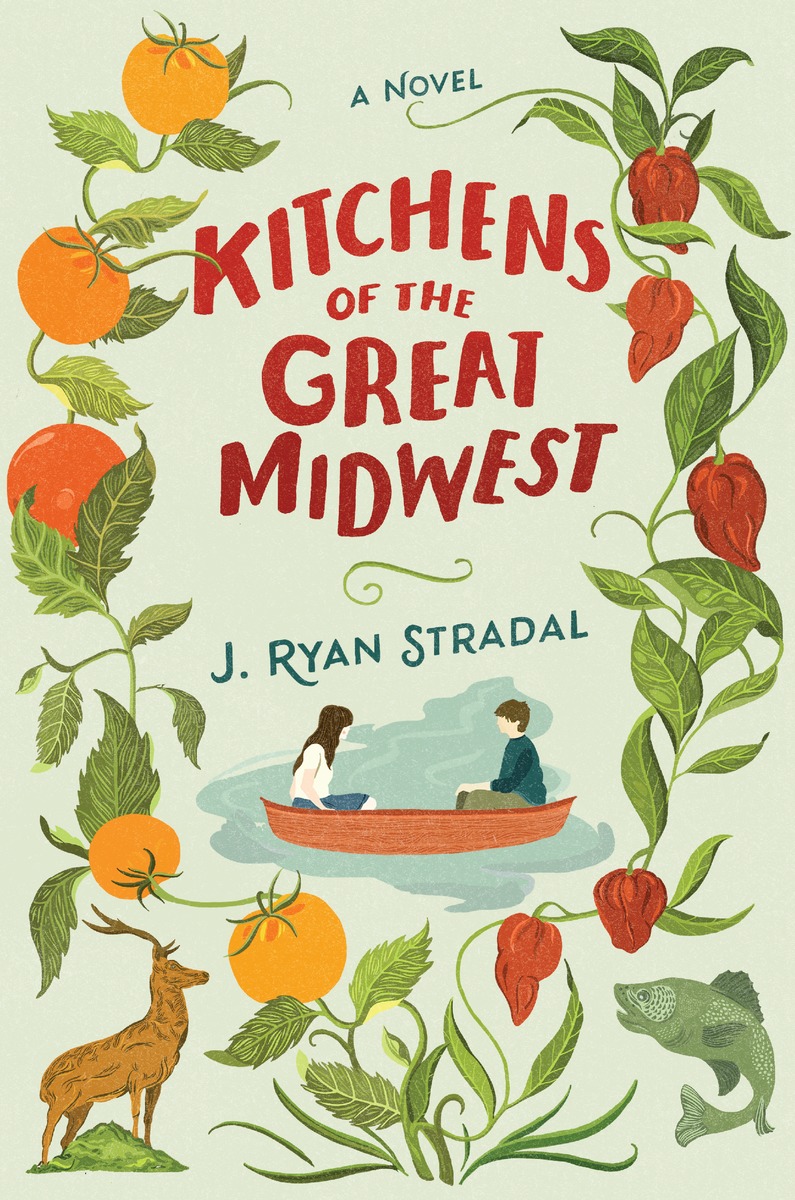
Kitchen tale tantalizes with tasty narrative
J. Ryan Stradal has never been to northern Michigan. Nonetheless, this did not stop him from moving one of his pivotal characters to “a small house in Petoskey, outside the town of Charlevoix,” near the apex of his new novel.
“Kitchens of the Great Midwest” is Stradal’s first novel, and as the unconventional love story wends toward its conclusion, Cindy, an aging sommelier at the heart of a mother-daughter divide, lands in the north to salve her wounds.
“I wrote about it hoping I’d be able to come,” Stradal says with a laugh about his decision to move Cindy to northern Michigan.
As the story unfolds, Eva Thorvald comes of age in Minnesota heartland country before her rise to international culinary phenom, a chef who, as the story concludes, is able to tell her life story “’through the ingredients in this meal.’”
Daughter of Lars and Cynthia, Eva traverses the culinary landscape of the Midwest, angling through chapters developed around such traditional foods and recipes as lutefisk, sweet pepper jelly, and venison. Each division concerns the point of view of one or another of the contributing characters, before the story lands at “The Dinner,” where Stradal reunites several of the characters who have drifted in and out of Eva’s sometimes tumultuous but always tasty life.
“When I first sat down to write I knew what the ending was,” Stradal says. “I wanted to tell the story of a dinner party through the guests and work backwards.”
At that final dinner party, Eva feeds several of those pivotal characters she encounters on her trip from toddler to chef, including Will Prager, Eva’s teenage crush. In high school, Will thought Eva “a woman whose hand he could take and stride into the darkness with.” He thought, “They could fix each other without even trying,” though as with many of the characters that Eva encounters, the fix won’t work.
Eva's story unfolds chiefly through the points of view of the other characters. “I decided to put her at a distant point,” Stradal says of his decision to limit Eva’s perspective. Some of these other characters, like Octavia Kincade, do not make the final sit down, but nonetheless contribute important perspective to the developing narrative. Octavia, with a soul “broken like old bread and scattered in the snow for the birds,” fails to see the promise in Eva, though after some time away, when the two meet again, Octavia realizes Eva “hadn’t grown into being a woman, she had become a woman with an exclamation mark.”
“I like to write into a story and let the characters tell me what the story is,” Stradal says.
Food is central to the story, as it holds the narrative in place while the characters careen through tough times and flush times. The recipes in the book are from a cookbook that belonged to Stradal’s great-grandmother.
“I wanted to use old family recipes as much as possible,” he says. Recipes include pan-seared walleye, grilled venison, and dessert bars among others.
Less overt but no less important to the story is Stradal’s motif of music. From small Minnesota indie bands to the recognizable strains of Radiohead, Cake, and others, the sounds add a dimension of verisimilitude that enriches the story.
“Other than food I think music is the great mnemonic of our lives,” Stradal says. Will Prager’s high school bandmates in the Lonesome Cowboys even believe, “’You might just get a whole album of lyrics from just yesterday alone,’” after Eva presents him with a simple hug after a forgettable date spent walleye fishing.
More than a testament on food or music, however, the story is a look at enduring ideas about family. Cindy early on realizes she’s not cut out to be a mother, though she later worries that Lars might have spent “Eva’s entire life convincing her that somewhere, her cruel birth mother still existed as distant and unremarkable as a soldier in a foreign port.”
Of course, Cindy could not be more wrong, and that is to Stradal’s credit. His wide-angle blend of character and place illustrate in layers the influences that move Eva from gothic teenage kitchen helper to mysterious, but successful, culinary innovator.
In the end, Eva continues to woo diners around the world, while Cindy accepts she must “just live in the world she had created.” Together, this mother-daughter duo provides a wonderful read in “Kitchens of the Great Midwest.”

Uncle Walt Keeps Yawping
Wherever I turn these days, I bump into Walt Whitman. He lent me a line for a poetry anthology I edited, where I invoked his lilac metaphor, concluding, “Every leaf a miracle.”
My son, on the hunt for a classic, asked for a copy of “Leaves of Grass,” Whitman’s slender opus of purely American Romanticism.
Now John Marsh suggests Whitman can also save me from what ails me. In fact, Marsh believes Whitman might save us all.
"In Walt We Trust,” Marsh trades on many of Whitman’s poems to explain, “how a queer socialist poet can save America from itself.”
While the subtitle might strike some readers as hyperbole, in four slim chapters, with a couple brief interludes, Marsh details how Whitman and his poetry provide insight for rethinking death, debt, the decline of democracy, and more. “The result is a mix of biography, literary criticism, manifesto, and…self-help,” Marsh says in his introduction.
Associate professor of English at Penn State, Marsh admits his treatise springs from “relentless, disabling headaches” that first afflicted him in his late twenties, indicating “fully-grown doubts, not just growing doubts, about the meaning of life and the purpose of our country.”
While others “may quit their jobs, have an affair, or medicate,” at the onset of pain, Marsh instead drove to Camden, New Jersey, because he became convinced that Whitman, “the greatest poet America ever had…is the cure for what ails us.”
On the existential worry of death, Marsh explains, “Few remember (Whitman) as a poet of death.” For Marsh, however, “death is (Whitman’s) great theme, though he treats it unlike any poet then or since.”
Using “Leaves of Grass,” first issued in 1855, and other poems, Marsh explains how rather than nosedive into despair at the eventuality, “Whitman suggests that if you could see what he sees and experiences, these shared visions and experiences would reveal the hidden scheme of the universe.”
In “Crossing Brooklyn Ferry” from 1856, Whitman explains he is a part of the “’simple, compact, well-joined scheme,’” but more importantly, Marsh contends, asserts we are all part of this universal scheme, as we too “’shall cross from shore to shore years hence.’”
On wealth and democracy, Whitman is equally worthy of our attention. In “A Song for Occupations,” the poet explains “the role of economics in our lives,” wondering, “’Were I to you as the boss employing and paying you, would/that satisfy you?’”
His point of course is “money and property…are a dead end.”
Democracy, however, is not a dead end, as Whitman explains we must move “toward affection, toward friendship, toward a nation founded on care.”
Simple solutions cannot eradicate existential crises. But “In Walt We Trust,” John Marsh offers a clever examination of how America’s most notable poet might offer solace.
Good Reading.
www.monthlyreview.org


Tuesday, May 12, 2015
Barry Strauss on Julius Caesar
After more than 2000 years, what more can be said?
Turns out plenty if the story the assassination of Julius Caesar.
In “The Death of Caesar,” Barry Strauss, a history and classics professor from Cornell, recounts what has long been known but little understood by including up close assessments of those closest to Caesar, such as his young wife Calpurnia. More importantly, Strauss examines those, who while close to Caesar, are less well understood, like Decimus.
There is no doubting that Gaius Julius Caesar was assassinated on March 15, 44 B.C. or that the assassination grew from collective frustration over Caesar’s aspirations to control more and more of the decision-making in ancient Rome.
There is no doubt, either, about who participated in the assassination. Or about who used the chaos of the aftermath to advantage. What makes the story compelling then is the new angle from which to see what precipitated the famous murder.
Brutus and Cassius, the two conspirators made famous in Shakespeare’s version, certainly planned the attempt. Mark Antony and Octavian, Caesar’s adopted son, as certainly turned the confusion and commotion to advantage.
This is all well documented.
What Strauss gives in addition to the documented history is an analysis of the deep-seated animosities and anxieties each conspirator felt personally and collectively.
For example, Caesar consorted with Servilia, Brutus’s mother, leading some to speculate that the bad blood between the two men might have started as filial blood. It’s unclear what Brutus thought on this account.
There are divisions that are clear here, however. “Not easily cowed, Brutus was “not one of Caesar’s longtime supporters but a rehabilitated enemy.” Early in the Roman civil war, Brutus opposed Caesar’s objectives, but “Caesar showed his confidence” by making Brutus governor of Italian Gaul.
What Caesar viewed as calculating, though, may have proved his undoing, as Brutus grew more and more disillusioned, leaning more and more toward those who would unseat his mother’s lover.
Misrepresented by Shakespeare’s as Decius, Caesar’s ally Decimus was “(a) noble of impeccable pedigree,” who may have been the most important conspirator. He brought an allegiance that even the others did not have. “He had Caesar’s confidence and he had a band of gladiators,” both useful to the larger plot.
In his letters, Decimus, “ambitious, competitive, proud, and violent,” reveals he may have desired some of Caesar’s power, but he feared Caesar’s adoptive son Octavian, caught then between allegiance and ambition.
Once fixed on their objective, the group sought to bring aboard others of the right bent to carry out the plan. Before long, they were able to leverage enough of Caesar’s former allies and his current enemies to carry out the assassination.
After more than 2,000 years, some stories grow stale. Not so with “The Death of Caesar.”
Good Reading.


Monday, March 9, 2015
Tom McGuane Traverses Family Fault Line is Crow Fair
At the conclusion of his title story “Crow Fair,” Tom McGuane’s narrator understands he’s “getting to be…an old timer.”
McGuane, Michigan born and raised, is himself an old timer, but his new collection of short stories illustrates he still commands the form.
Like his running buddy Jim Harrison, McGuane now calls Montana home, so most of these stories are set in Big Sky Country, where his characters, old timers and some younger, lean into the troubles that accompany a range of ailments, real and imagined, but always family-themed.
These stories hover over fault lines.
In “Weight Watchers,” the narrator’s father moves in because, “My mother had thrown him out again, this time for his weight.” His father, it seems, is “insufficiently committed to his weight-loss journey.”
Over the next week, the two men, father—at more than 250 pounds, and son--a small town contractor who lives alone--shadow box through memories of earlier times. “My father believed that anything done for pleasure was escapism,” our narrator explains, illustrating the old man’s attitudes.
In a few short pages melancholy memories of how the narrator, who cannot “imagine letting anyone new stay in (his) house for more than a night,” navigates his largely unremarkable Midwestern upbringing.
In “Hubcaps,” McGuane heads back to Michigan to find Owen, whose parents, by midafternoon, “were usually having their first cocktails.” The boy escapes to the neighbors and the “baseball diamond that the three Kershaw boys and their father had built in the pasture across from their house.”
“Happy with his George Kell spot at third base,” Owen tries to avoid the unraveling of his parents’ marriage by accompanying Mr. Kershaw on arrowhead scavenging treks.
When more and more of his life delaminates, however, Owen tries to patch it together by adding to his hubcap collection, even wandering “the darkened parking lot” to do so, replacing the cohesion of a predictable family structure with the lonely pursuit of simple law breaking.
In the title story, Earl, a loan officer, and his brother Kurt, an orthodontist, move their mother to a rest home. Though their father “was a mouse” who “looked like a corkscrew” the last few years of his life, their mother “was a queen.”
Now in the throes of dementia, however, she recollects her old lover “Wowser,”as the middle-aged brothers try to reconstruct their youth to find some sense in her senseless ranting. Ultimately, Earl invents “a gentler interpretation of (their) mother and the choices she made.”
In “Crow Fair,” McGuane, author of more than a dozen other books, returns to familiar ground, whether the Midwest or the Big Sky, to examine the fault lines, real or imagined, of family.
Tuesday, May 27, 2014
Paddle At Your Own Risk
In a recent “New Yorker” analysis critic Peter Segal concludes, “The crime tale has become to Scandinavia what the sonnet was to Elizabethan England: its trademark form.”
I’m not sure I’m ready to dub Vidar Sundstol William Shakespeare’s heir, but in “The Land of Dreams”, he serves up a thoughtful thriller.
Winner of the Riverton Prize for best Norwegian crime novel of 2008, “Dreams” is now in English, published by University of Minnesota Press.
As the story opens, local conservation officer Lance Hansen angles his state issue pick-up truck into what he expects to be another uneventful day along the shores of Lake Superior on Minnesota’s northeast coast in Cook County.
In fact, when he meets a new colleague, Hansen tells him he’s lately been all about the usual. “’Brawls and boozing at a couple campgrounds,’” is the best he can do, though he believes “his job was far more preferable to walking a beat in some place like Duluth or Minneapolis.”
But when an illegal tent pops up near the mouth of the Cross River, Lance investigates. Only five pages in, and the simple tent check reveals the brutal murder of a visiting Norwegian canoeist, upending the sleepy tourist community in the heat of the summer season.
Because the murder took place on federal land, and the victim is Scandinavian, the FBI weighs in, inviting celebrated Norwegian homicide detective Eirik Nyland to assist. Nyland’s detached expertise serves a perceptible counterpoint to Lance’s local leeriness after his logger brother Andy pops up repeatedly in the investigation.
“Until he turned thirty-seven, Lance Hansen was more interested in the past than the future,” we learn, as the story runs deeper than Lance, “’our local genealogist,’” when he chases not one mystery but two. Roots running generations deep anchor Hansen family lore to Thormond Olson. Emigrating from the old country at the end of the 19th century, Olson, Lance’s great, great grandfather, trudged many a snowy mile, surviving a shocking cold before washing up in Cook County.
Thormond’s legend, however, veers uncomfortably close to the disappearance of Swamper Caribou, a local Ojibwe trapper swallowed by the vast wilderness. And though Lance cannot separate the two mysteries, current and former, he wants to run quickly from what might scar him and his.
In his “New Yorker” piece, Segal also explains how in Scandinavia, “The crime novel (is) an effective vehicle for the expression of fears and resentment.” Sundstol goes further, using his novel to render social commentary, albeit made easier because he’s focusing on American culture here, not his own. Of the general disinterest surrounding Swamper Caribou’s disappearance, readers learn, “A missing Indian was simply not something that required attention…there was nothing to be done about it.” This is because, “Many white Americans respect the Indian cultures, but it’s a form of respect that involves no…risk.”
Some of the writing here comes off as wooden, though largely in dialogue, underscoring the challenges of translating regional idioms. The supporting characters, however, including the doughy Sheriff Eggum and Lance’s peripatetic brother, ring believably enough.
Vidar Sundstol might not be Shakespeare, but in “The Land of Dreams,” the first installment in his “Minnesota” trilogy, he demonstrates why Scandinavian storytellers continue to captivate readers.
Thursday, May 15, 2014
Everest Story Reveals Calm Amidst Storm
In his new book “After the Wind,” Good Hart author Lou Kasischke says there was a moment when, “A veiled force overpowered me.” His heart pounding, his fingers frostbitten, he writes, “Everything else went quiet.” Kasischke was just a few hundred feet from the summit of Mount Everest.
What happened next encouraged Kasischke to publish his first account of that notable climb.
“What meant everything was what it would take to overcome a mountain of ambition and pressure to succeed, and to make a hard choice,” Kasischke said.
Kasischke did not make the summit, but says instead he found direction in “the still, small voice” that he heard “after the wind.” The 1996 climb, the subject of other books before now, is notable because eight climbers died. Trouble came from many corners on that climb, when human error put climbers in dangerous weather well past an agreed upon turn-around time. Until this past April, this was the most deadly day ever on Everest.
Kasischke, part of an experienced team climbing with veteran guide Rob Hall, believes some of the troubles came from the presence of journalist Jon Krakauer. Working for Outside Magazine, and later famous for “Into Thin Air,” an account of the 1996 climb, Krakauer put the other climbers on edge. His online updates of the expedition reported members’ climbing skills to the world in real time. Kasischke acknowledges that Krakauer did aide others in the aftermath, but when asked if Krakauer’s presence influenced the outcome, says, “You bet it did.”
Hall summited Everest previously, as had his counterpart Scott Fisher, another prominent guide on the mountain that season. Hall and Fisher, friends but also competitors, each hoped to guide their clients to the top of the world, and Kasischke believes this competition, though amicable, also led to the tragedy. The two skilled guides unexpectedly decided to push for the summit on the same day: May 10.
In his chapter on “The Hedge,” Kasischke explains, “Rob and Scott hedged the business and publicity competition by agreeing to go to the summit on the same day” deciding on “a shared outcome in which both expeditions would get to the top of the world or neither would.” He admits he was not privy to their discussion, but says, “There was no upside to going together.” He believes emphatically, “There would be no tragedy in 1996 but for going on the same day.”
This is not simply a climbing story, however. “After The Wind” is also a love story. Kasischke wrote what he initially referred to as “the pages,” some 160,000 words, soon after his experience. He’s published only recently, though, because, “The reasons for writing were different than the reasons for publishing.”
The strength to turn back when he didn’t want to came from Sandy, he says, his wife of nearly 47 years. “I just wanted people to know her part in the story. I wanted to honor her.”
Sandy’s role in the events is traced early on to chapter two, “The Ritual.”
Kasischke, who has climbed big mountains on all seven continents, explains the ritual of initiating a climb always involved Sandy. “We both knew if Sandy said no that was it.” In 1996, unlike ever before, she asked Lou to promise, succeed or not, he try Everest only once. “This was the first time I could remember Sandy asking for anything,” he writes. Kasischke agreed, because it “was a fair request.”
Adventure story and love story, Kasischke writes that their story is even more about how we all confront our own daily dilemmas. “How do you prepare for the challenge within,” he wonders in the book. “What prepared me and influenced me to determine the outcome was this personal relationship; it was the love.” He says, “What made the difference between life and death resided in my heart.”
With carefully rendered pencil drawings from Kasischke’s Good Hart neighbor, Jane Cardinal, “After The Wind” takes readers along on an adventure already known around the world. Until now, however, the story of how this Northern Michigan climber faced down his fears of failure and found the strength to make the right decision has been known to only a few.
“After The Wind” is available at Between the Covers in Harbor Springs, as well as McLean & Eakin in Petoskey, or from Amazon.com. More information on the book is available at Kasischke’s website www.afterthewind.com
Lorrie Moore's Bark has subtle bite.
I wanted to ignore Lorrie Moore’s new collection of short stories.
“Bark” is getting so much praise from so many corners; I wanted to find a flaw. I didn’t want to agree with others, but I confess, for the most part, I do.
Regarded a master of the form, Moore nonetheless took a fifteen- year hiatus after her last collection “Birds of America.”
She returns with eight tales of men and women in crisis and confusion, certain only of the missing safety net as they toe the high wire of love and loss. Her women are troubled, her men awash as much in determination as doubt.
In “Debarking,” Ira, divorced six months, wobbles between his worry for his young daughter Bekka and his new, but awkward relationship with the pediatrician Zora. Bumping into these bookends, he is convinced he is “watching history from the dimmest of backwaters, a land of beer and golf.”
Zora’s relationship with her sixteen-year old son Bruno, monosyllabic and doughy, vexes Ira. His Bekka welcomes a new cat, but can’t reconcile Ira’s pronouncement that, “’We cheat the power of time with our very brevity.’” Bruno, “broad –shouldered and thick limbed,” wedges between his mother and Ira. After a communal dinner, “Zora and Bruno, some distance behind him, began to jostle up against each other, ramming lightly into each other’s sides.” Their physical closeness, what Ira misses in his life, unsettles him, played out weirdly by mother and son.
Moore certainly draws me in with her opening story, but she as quickly loses me with “The Juniper Tree.” Though there is subtle brilliance in the idea that the narrator and her middle aged friends recognize how, “In rejecting the lives of (their) mothers, (they) found themselves looking for stray volts of mother love in the very places they could never be found,” I can’t appreciate that the three friends are visiting the ghost of their recently dead friend.
The introspection is clever, but the premise if too off-putting to work nearly as well as some other stories here.
Another such workable story is “Paper Losses,” a glimpse into the failing marriage of Kit and Rafe. Kit realizes in time, “A woman had to choose her own particular unhappiness carefully. That was the only happiness in life.” With Kit, their three young children both a wonder and a distraction, she understands, “It was like being snowbound with someone’s demented uncle: Should marriage be like that,” she wonders.
Of course, marriage should not be like that, but in Moore’s stories, most all relationships are, by turns banging dangerously against the rocks, then listing idly in still but deep waters.
Her most solid effort is “Wings.” KC and Dench wash up on the edge of poverty, marooned by a gentrified disinterest. KC, a failed musician, recognizes how, ““The gardenia in (her) throat, the flower that was her singing voice…had already begun its rapid degeneration into simple crocus, then scraggly weed.”
KC cultivates instead a symbiotic relationship with her widower neighbor Milt, who exclaims, “It’s lonely in this neck of the woods,” amplifying the heart of Moore’s most consistent theme.
I resisted “Bark” as long as possible. But Lorrie Moore’s command of short story makes these new selections impossible to ignore.
Good Reading.
Sunday, October 2, 2011
Pick a column, any column
Choose any Nick Kristof column dealing with the humanitarian crises in Africa, and comment here. Mention the specific column and cite at least two of Kristof's phrases or sentences in your response.
Any questions? Just ask.
http://topics.nytimes.com/top/opinion/editorialsandoped/oped/columnists/nicholasdkristof/index.html?match=any&query=Africa
Wednesday, September 28, 2011
Summer Reading
The other night at dinner my wife wondered aloud why anyone, myself included, would assign summer reading? I didn't have a prepared answer, except to say I thought some of the discussions that came out of this year's assignment had been productive. I also thought the two books worked well together, and there is always the fact that likely few if any students would have read either of these books had I not assigned them.
So now I want to hear from those who were required to read them. Tell me what you think about the idea of a summer assignment, and what you thought in particular about the two books in question.
How can readers have such diverse reactions to the same book? Is this a comment about the books or about the readers, and if it is about the readers what does this say about what we as readers bring to the process?
Wednesday, September 21, 2011
Once Upon A (Michigan) River
Margo Crane first enchanted readers in Bonnie Jo Campbell’s 2009 short story “Family Reunion.”
Meeting her again in Campbell’s novel “Once Upon A River” is an even larger treat. Margo, the Annie Oakley-wannabe heroine of this latest novel, has been compared to Huck Finn and Odysseus.
These comparisons, though, minimize the decency of the teenage Margo, who is not so much larger than life but rather as unadorned as life. A sharp shooting interloper and outsider in the clannish Murray family of Campbell’s fictional southern Michigan burg “Murrayville,” Margo’s yearnings for family and purpose personify the same fundamental longings recognized by everyone who has experienced family turmoil.
Cast adrift when her mother abandons her and by her father’s inability to understand her untamed impulses, Margo early on learns to fend for herself around the riverside home she shares with her father, just across the water from the Murrays. In part, Margo’s outsider status is sealed long before she is born, as her father, Bernard Crane, is “born the bastard son of Dorothy Crane and Old Man Murray during his bout of infidelity.”
When calamity soon visits, Margo discovers, “For the first time in a year, she was, horribly, part of the family.” The Murrays are expected to rally around the teen at this crucial moment, but she instead lights out along the Stark River in her teak rowboat “The River Rose,” given to her by her grandfather, Old Man Murray.
Campbell’s evocation of the elemental pull of the river on Margo’s burgeoning awareness is consistent as well as convincing. On the first night she spends at home without her father, “She smelled the river in every corner of the house, in every molecule of the air, in every pore of her own body.”
Margo next embarks on a series of sometimes heartbreaking but always heart-rending adventures, involving a cast of low brow characters like Brian and Paul, meth-making brothers who prowl the river for treasure, real or imagined, and Michael, whose river dog Cleo Margo renames “King,” because though a female, she stalks the river like a kingfisher.
Her journey’s purpose, ulimately, is to find her mother Luanne, whom Margo remembers as cocoa butter and white wine. Luanne left her husband and daughter, unable to cope with the closed nature of Murrayville. Rumored to be upstream, in Heart of Pines, Luanne becomes Margo’s destination.
Upstream or down, Margo pilots the banks of the Stark River as she navigates the edges of society. Unwilling to return to the stifling expectations of Murrayville, she instead journeys in and out of trouble, accompanied always by the .22 caliber Marlin rifle she appropriates from uncle Cal before leaving the family decay.
Eventually, in the emphysema-riddled Smoke, his dog Midnight, and his friend Fishbone, Margo finds both purpose and place, though she is no more settled than before, as Luanne remains in still uncharted waters.
“Once Upon A River” captivates as it startles, because Margo Cranes leaves in her wake a tale illustrating the confluence of calamity and connection.
Good Reading.
Alex McKnight Returns in Misery Bay.
Fictional sleuth Alex McKnight is back and his fans are pleased, but no more so than his creator, Michigan-born author Steve Hamilton.
Returning in his eighth novel, McKnight ventures west from his home base in Paradise, to ominously named Misery Bay, where he is asked to investigate the suicide of a college student, a young man who appeared to have it all, but who instead hangs himself from a large, lonely tree near the shores of Lake Superior.
After a five year hiatus that saw Hamilton publish a second stand-alone novel “The Lock Artist,” Hamilton decided McKnight’s return should have the reluctant hero veer west. “I knew he had never gone west in the U.P.,” Hamilton says. “I knew it was very different out that way; I knew he’d have to wander out that way some time and get in trouble.”
Hamilton knew the only way he could have McKnight find the mystery of the western U.P. was to travel there himself, so he drove the Seney Stretch along M-28, eventually landing in the tiny town of Toivola. When he saw the nearby sign for Misery Bay, Hamilton knew he had found the right spot. “It’s not even on the map, unless you have a really good map,” he says of the bay.
Absorbed in an environment he describes as “forlorn and forgotten, he began to imagine the details of his new project. “ Like any crime writer, I asked myself what’s the worst thing that could happen here,” before fixing on the new book’s entry point, the suicide of a promising young man. He says the location is perfect for Alex’s next adventure, “Because it’s such a lonely place and there’s this big tree overlooking the lake.” The tree figures prominently in the story.
As he has for all his Alex McKnight novels, Hamilton resurrects some other colorful characters, chief among them Jackie Connery, owner of the familiar Glasgow Inn in Paradise, the spot McKnight is likely to be sipping on a cold Molson while waiting for something to happen. Jackie is as taciturn as ever, opening the story by telling some unsuspecting snowmobiler in a pink suit to leave and never come back when the man tramples on the local affinity for Lake Superior.
The first major twist in the story comes when Roy Maven, another recurring character and chief of police in Sault Ste. Marie, calls on McKnight with the hope of enlisting the sleuth’s help. Turns out the dead boy’s father is an old colleague of Maven’s. “Theoretically they’ve always been on the same side, even though they knock heads sometimes, Hamilton says of the tension in the relationship between Maven and McKnight.
As the boy’s father struggles to make sense of the suicide, he turns to his old buddy Maven. “It’s like the ultimate heart-breaking mystery,” Hamilton says of the weight of the suicide. Of the questions surrounding what drove the young man to suicide, Hamilton believes, “It’s almost an impossible question to answer,” which necessarily becomes the novel’s purpose.
Enlisted because he might be more likely to get the boy’s college pals to open up, McKnight reluctantly, as always, agrees to give it a shot, expecting to find little useful information, eventually uncovering more than enough to unravel the details that resolve the case.
Hamilton believes Alex McKnight has evolved since the first novel in the series, the Edgar Award winning “A Cold Day In Paradise,” published in 2000. “He still blames himself for what happened,” Hamilton says, referring to the shooting death of his partner when McKnight was a Detroit police officer, a shooting that occurred 14 years earlier. “When you first meet him, it’s been a few years since all this stuff happened in Detroit and he’s hoping not to deal with it.”
Dealing with it is a major current in the novels. McKnight has moved north to forget, but he can’t. Surrounded by his past, both personal and professional, the retired cop finds he’s constantly being called upon by new friends to help.
Though Alex McKnight took a hiatus, Hamilton did not. Still working his day job at IBM, he also managed to keep writing, turning out stand-alone mysteries in “Night Work,” and “The Lock Artist,” both well received by critics and readers alike. “It’s strange to think of a fictional character as needing a break,” he says of McKnight, “but he really did.”
Hamilton also wanted to take a break from his fictional creation. “I never want it to get easy. You can tell when someone hasn’t burned a lot of calories on a middle book,” he continues, explaining he didn’t want readers to think of him this way.
He believes the experience of the stand-alone books has been helpful. “I hope I became a much better writer having gone through it.” He feels the break from the series was necessary. “That was all I knew, and I sort of had this idea ‘that you need a break or you’d be stuck.’”
Having returned to the series, Hamilton has plans for even more. “I can’t imagine ever not wanting to go back to Alex,” he says. “I’m working on the next book, and it’s Alex. I’m sure I’ll stay with him for the next two.”
About his absence from Michigan, Hamilton says the space is helpful to his writing about home. “If you’re in the minute details every day and you get to look back, you might miss something.” From the distance of his New York home, he believes, “I can look back and know what Michigan is. Without hesitation, Hamilton says, “I know for a fact I couldn’t have written these books if I hadn’t moved away and had a chance to look back.”
Steve Hamilton will be back in Michigan beginning July 12 with a stop in Montague. He will conclude his tour with a visit to the Mackinac Island Public Library on August 26. He will sign books in Traverse City at Horizon books on Tuesday, July 19 from 12 p.m. to 2 p.m.
For more details about his books and his book tour, visit authorstevehamilton.com
Sunday, April 17, 2011
Bood, Bones, and Butter
The success of “Blood, Bones, and Butter” is that chef and restaurateur Gabrielle Hamilton turns her “inadvertent education (as) a reluctant chef” into a memoire as much about food as it is about family dynamics and cultural criticism. That she does this with metaphors concocted as carefully as her handmade salad dressings leaves a pleasant finish on the palate.
The owner of the New York’s trendy though classic Prune, Hamilton has written regularly about food in such magazines as “Bon Appetite” and “Food & Wine.” She has also been anthologized in “Best Food Writing.” Her University of Michigan writing degree does her well in her first book as week.
Raised in the Delaware River valley of New Jersey, Hamilton came up in a house full of older siblings, with an artist father and a French mother who navigated a six burner stove like a practiced dancer. Her mother cooked rustic fare. “She instilled in us nothing but a total and unconditional pleasure in food and eating,” Hamilton says.
The petite blonde cut her restaurant teeth waiting tables at local eatery “Mothers,” before moving to New York and the cultural weight of cowboy chic at the Lone Star Café. Here she learned “working her (expletive) tables,” meant pocketing cash meant for the cash register, then splitting it with the bartender.
Once she learned her lesson, Hamilton embarked on the 1980s odyssey of cocaine and sleeping late. The lesson also soon landed her in jail.
Both ahead of and behind her peers, she eventually enrolled at Hampshire College, intent on regaining some semblance of middle class expectations. Her history kept nagging, however, so Hamilton returned to New York and restaurant work.
Soon came gigs in commercial catering kitchens, where she met plenty of “ever-interchangeable warm (bodies) in a rented chef coat who knew not one thing about what a homemade mayonnaise might be.” The scale of such operations showed Hamilton that what often passed as good food was nothing more than quickly concocted combinations of second-rate ingredients, dressed up with clever presentations. The sheer quantity of the expectations demanded such shortcuts.
Next came a four summers long stint at a Berkshire summer camp, where Hamilton served baked chicken and tater tots by the pan-full, but also insisted on local produce and dairy.
Of her mother-in-law, Hamilton says her eighty-year-old Italian mother-in-law “cooks eggplant that satisfies like meat, grows her own olives, peels apricots from her own trees, and sun dries tomatoes to make her own tomato paste.”
Hamilton makes a fine meal of "Blood, Bones, and Butter."
In Which Brief Stories Are Told
Ferris State University English professor Phillip Sterling believes Northern Michigan is not easily categorized. Sterling, an accomplished poet, has recently published a collection of short stories, many of which take place in this area.
The prevailing narrative thread in his book of short stories, “In Which Brief Tales Are Told,” is the uncertainty between what is known and what is suspected. In each of the fifteen stories, narrators, some omniscient, some confined, unravel details that often leave as many questions as they answer.
Published as part of the Made In Michigan Series from Wayne State University Press, “In Which Brief Stories Are Told,” demonstrates Sterling’s poetic tendencies in prose narratives. Case in point is “The Small Bridge.” In the span of six pages, Will and his future/ former wife Joy move from an early encounter raking leaves to marriage, then onto divorce, all the while imagining their daughter Artemis, and how the failed relationship reveals their most intimate feelings.
The raking, “no more than stench of death and decay,” serves as an appropriate metaphor for their failed relationship, made only less so by the wonder of their daughter. Here, Sterling’s narrative veers to the heart of the matter, as we learn, “What should be said instead is how little they knew of each other at this point in the story.”
In “An Account in Her Name,” Sterling’s narrative approach is more traditional. A middle-aged woman returns to Northern Michigan to meet a banker about a savings account her long missing sister kept. In the unfurling of events, readers learn that the sister, a teenage lifeguard and swimming instructor at a public beach in Beulah, left a legacy of not only mystery but also insight
Edie, the lifeguard gone AWOL, worked hard at their father’s restaurant, a place he buys in order to move his family north, to escape the sinister possibilities of the city. His family is slow to buy into his dream, though Edie works hard to keep up appearances.
In the span of a summer, Edie disappears while returning North from her studies at Kalamazoo College, unleashing events that bring down the dreams of those around her, including her parents and her sister. When the sister, the story’s narrator, conducts her banking, however, the mystery is at once renewed and reduced.
Monday, February 28, 2011
How The West Was Won
Revision as history is a dicey business, so when he announces at the end of his new book, “Strange combinations of forgetting and remembrance followed the death of Crazy Horse,” Thomas Powers acknowledges the uncertainty in taking up any long known but little understood story.
“The Killing of Crazy Horse” is Powers’ attempt to explain the 1877 death of one of the most iconic Indians in all of American history. Throughout his investigation, Powers remains steadfast in his purpose not to cast blame but to unravel what has long been hinted at but never before now publicly proven.
That Crazy Horse held a special place of disgust in the white world is easily substantiated. Present in 1876 at the Little Big Horn river in Montana, the Oglala chief was largely seen as the cause of Custer’s last stand. With victory comes the right to tell the story, but with defeat comes the insistence on assigning blame. This blame, though nearly universal in the annals of the government’s explanations about what happened at that Montana outpost, is less clear in Powers’ retelling.
The larger context of the story, however, reaches back beyond this single battle, pointing fingers at a host of characters, both Indian and white, who, through circumstance or conspiracy, combined to find Crazy Horse at Nebraska’s Fort Robinson on the eve of his death in 1877.
Powers is careful to describe the results as “the killing,” though many might conclude or suggest it was murder. What has long been understood is Crazy Horse’s position in the Sioux society. He was a venerated chief, a “shirt wearer,” and a celebrated warrior. What he might not have been was any more responsible for Custer’s death than any of the other Sioux present at the fateful battle in 1876.
The flashpoint that led to the killing of the Oglala chief was undeniably the death of Custer. Powers, as have others, however, demonstrates how Custer and Major Marcus Reno likely erred in their maneuvers to surround and defeat the Indians. Indeed, Powers points out, how Reno faded from involvement when the battle flashed. “About Reno even the word cowardice was being used,” we learn.
Regardless the blame at Little Big Horn, the circumstances surrounding the death of Crazy Horse point to an amalgam of Indians and whites whipped to chaos and brutality not simply by the death of Custer, but by indecision, uncertainty, and cultural clashes that had boiled over once gold was discovered in the Black Hills of the Dakotas, traditional Oglala hunting grounds.
Implicated in this confusion of personalities is Little Big Man, once Crazy Horse’s friend, but at the end his adversary, as well as General George Crook, a veteran of the Civil War who always thought his successes overshadowed by those of Sherman and Sheridan.
Without the published accounts of the mixed blood scouts, those who interpreted between Indians and whites, this story might never have been recounted. The diaries of Billy Garnett and James Bordeaux are most compelling.
“The Killing of Crazy Horse” provides an insightful look at one of the most well known but little understood moments of American history.
Good Reading.
What Are We Fighting For?
As a precocious kid coming up in the 1970s, I was drawn to the editorial page of the morning newspaper, where I first discovered Gary Trudeau, with his irreverent but accurate portrayal of American narcissism in the form of “Doonesbury.”
Andrews McMeel Publishing has recently issued “40: A Doonesbury Retrospective,” a compendium of every strips published since the comic launched in 1970. Also included are brief chapters by Trudeau on his most significant characters, including Mike Doonesbury, Uncle Duke, Zonker Harris, and others.
At the beginning, Trudeau explains what the book is not. “It’s not about Watergate, gas lines, cardigans, Reagonomics, a thousand points of light, Monica, New Orleans, or even Dubya. None of that.” He is also sure readers will be “relieved” at this news.
Trudeau is confident readers are not interested in “decoding long-expired topical material.” He explains that the book is instead an attempt to show “how it felt to live through those years.” This coffee table sized read includes 13 percent of the 14,000 strips published.
His character’s and his comic strip’s history is all here, nonetheless. The strip began, as most regular readers will already know, while Trudeau was an undergraduate. His first character was B.D., inspired by a college pal. But when syndication came, he knew was necessary to expand his character pool, so soon after, between 1970 and 1974, came the additions of Mike Doonesbury, Mark Slackmeyer, Joanie Caucaus, and intrepid CNN newsman Roland Burton Hedley, Jr.
A quickly noticeable feature of the strip’s evolution is the development of the drawing style and coloration. The first few panels are black and white, the outlines suitably shaded, but less structured and less defined than those of later efforts.
That evolution is also evident in the character’s dialogue. Whereas Mike and B.D. are largely concerned at the outset with what college life might offer, whether there are enough girls to meet a mixers, or the power of campus protest, the acceleration into topics of national significance and lasting impact is remarkable for its historical significance.
Richard Nixon might not make an obvious appearance, but nonetheless, here are Mark, Mike, and B.D. handing out awards to “the men and women who made Watergate a reality.”
Just when it appears Trudeau and his imaginary friends might stay fixed on matters of national significance, however, they veer back toward the ordinary, such as when Mark’s father announces to his still sleeping son, “Yessir, tomorrow’s the first day of college and it’s time to shake down the old man for the upcoming semester.”
Trudeau's most iconic character, however, is Uncle Duke. Modeled on bombastic journalist Hunter S. Thompson, Duke is memorable, whether lambasting his CIA intern for launching a Predator drone, or praising his Samoan aide for mixing a pitcher of daquiris.
For a look back at who we are, check out "40: A Doonesbury Retrospective."
Good Reading.
Saturday, December 11, 2010
Lord of Misrule
Winner of the National Book Award for Fiction recently, Lord of Misrule is an odd book. It isn't so much that the setting or the story arc are unorthodox; the story is set in a broken down horse racing world on the east coast and populated by characters with names like Medicine Ed and Suitcase. What makes the novel unusual, at least in contemporary fiction, is the narration. Where dialogue is concerned, dialect or vernacular has long been acceptable and at times preferable. But in narration, the deal with readers has always been that authors would revert to standard English usage. This is not the case here. The narration is rendered in half syllables, run-on sentences, and dropped suffixes. As well, the dialogue traffics in the relatively modern convention of not using quotation marks. I'm not sure the work isn't influenced by the style of Cormac McCarthy or Mark Twain.
In his slim treatise on the relationship between readers and writers, B.R. Myers, takes to task the new lords of fiction, criticizing McCarthy, Don Delillo, and others for their ventures into the ridiculous. I keep wondering what Myers will have to say about Lord of Misrule. I keep wondering what average readers will have to say as well.
The Golden Mean
In the early part of Anabel Lyon’s new novel “The Golden Mean,” Aristotle proclaims, “In the ideal state, the education of children will be the highest business of the government.”
That the book takes as its narrative arc the relationship between the famous teacher and his most notable student, Alexander the Great, offers a creative look into their well-known relationship, if not for a careful examination of his maxim.
Approaching middle age, Aristotle is summoned to Pella by his boyhood friend Philip, King of Macedonia. Along with his young and less than worldly wife Pythias, the philosopher embarks on a course that has long been considered a crossroad of history; the teenage Alexander and the aging thinker shadow box through their lessons, sometimes working together, other times at odds.
The novel is much more, however, than the simple amalgam of teacher and student. Aristotle’s heritage shades the story. He longs to return to Athens, to the Academy, where he can put aside the worry of daily life, the quotidian complications of maintaining his household, navigating the pitfalls of marriage, his young wife’s pregnancy, his king’s expectations, as well as his own desires.
This simplicity is not to be, however, as Philip leaves to expand his empire, expecting Aristotle to remain in Pella to provide some ethical stability and philosophical inspiration to his son and his mates. This maturing cadre of aristocrats challenges the old thinker.
For his part, Alexander suffers blackouts while in battle, committing atrocities on the battlefield he is later unable to recall. His behavior, recalled by others, clearly abhorrent, is a counterpointed by Aristotle’s own ignoble foray into battle. He serves with the medics, where he continues to develop his conclusions. He recognizes, “There is, too, the matter of purpose; can one say the soul is the purpose of the body? I feel a wooliness there, a gap in the teeth of my logic.”
Alexander and Aristotle find in each other their own aspirations, but also their own failures. Aristotle wishes for more worldly experiences, but knows these are fleeting, and because of his lineage traced from Socrates, he knows is constantly in pursuit of restraint.
This equilibrium is the golden mean, the balance between access and excess; the tipping point between mania and moderation. For his part, Alexander, raised by an ambitious father and a doting mother, wants for a more cerebral existence, but recognizes his inability to hold temptation at bay. Side by side, the two demonstrate both the height of human possibility, as well as the depth of human suffering.
“The Golden Mean” is Lyon’s first novel. Her writing blends an earthy diction with a
Sunday, November 14, 2010
Finders Keepers
Each summer, my Mackinac Island backyard gives up a few archeological treasures. The site of a former blacksmith shop, the soil is rich with historical castoffs.
Though no one else is ever vying for these finds, Craig Childs’ book “Finders, Keepers” put me in mind of how tenuous is the relationship between searchers and their finds.
Childs, author of “Animal Dialogues” and “Soul of Nowhere,” trades on his experiences of the desert southwest to frame his thesis. However, what might appear obvious to some, namely that the dead do not continue to claim their castoffs, is not as obvious as Childs navigates the ethics of archeology.
“Spitting potsherds” as a youngster, Childs graduated to “unaffiliated backcountry aficionado,” and eventually backcountry guide. All the while, Childs was honing his finding skills, while developing his keepers’ ethos.
His conclusions are derived from his own experiences, as well as the experience of others, both those Childs applauds and those he loathes. One of the latter is Jack Haralson. An insurance salesman, Harelson was also an amateur archeologist, who once dug up “a 2,000-year-old sealed torso-sized basket, heavy with objects inside.” Among the objects inside is “a mummified boy who had been about four years old when he died, and below his leathery corpse was another mummy, that of a girl about ten years old.” Harelson kept the loot and buried the mummies in his backyard. For his pains, he spent eighteen months in prison and a $2.5 million fine.
On the other side of the equation are Emil Haury and Julian Hayden, also archeologists who explored the southwest, also discovered mummified remains, but who donated their finds to science. “The distance between these two ends of the spectrum,” Childs writes, “seems like forever, but it is not.”
Guiding a reporter, who is interested in the subject, Childs confronts the questions of ethics as they search for artifacts in the Arizona desert. “I did not want to force my own ethic on her,” he states. “We want to be the first ones to bridge the gap,” he says, “clearing the dust away and letting in light.” What he understands, however, is “if we opened it, the seal would be broken. It would be forever changed.”
This, of course, is the rub. “There is a difference between finding and keeping,” Childs warns. “The two are often lumped together in one action, but there is a blink that comes in between.” This blink is the territory where Childs finds questions that do not necessarily have clearly defined answers. “We have no single agreed-upon way of treating the past,” he reasons. “Behavior varies from person to person.” This variation can be problematic, causing either derision or adulation.
Childs suggests a direction, courtesy of James O. Young, of the University of British Columbia, who believes, “Artifacts ultimately belong to the cultures that made them…if they are proven to have had a genuine, substantial, and enduring significance to the people. If they aren’t so significant, it’s finders keepers.”
Subscribe to:
Posts (Atom)